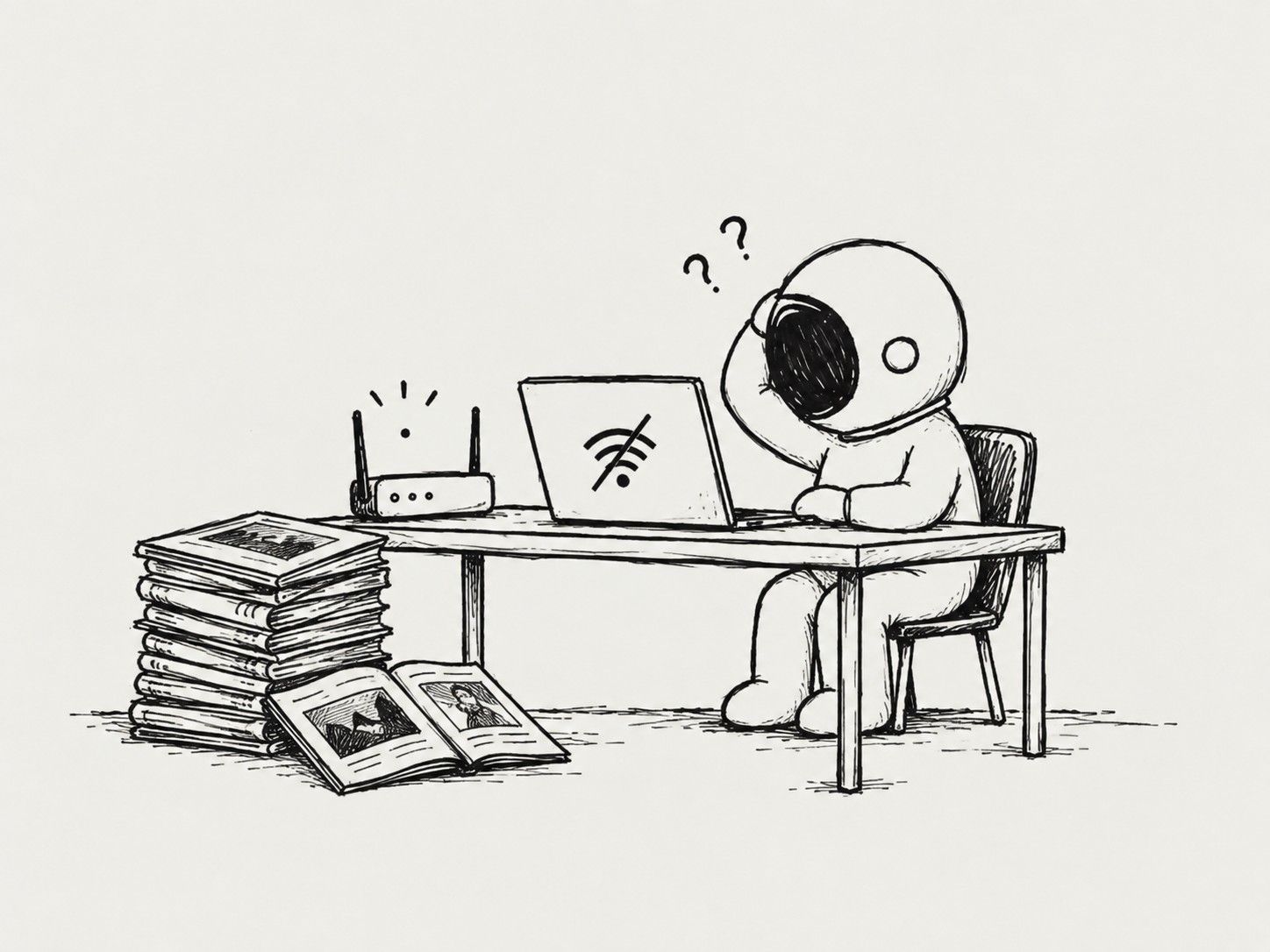
Today my Win internet went down, leaving me with the most painfully human alternative imaginable: reading so I wouldn’t get bored.
The tragicomic part is that I religiously pay for a WIRED subscription and have a small tower of untouched print issues sitting around, basically functioning as a monument to my own procrastination.
Under normal circumstances, I would have followed the usual protocol: curse at the router for a while, wait for the support bot to tell me to restart the modem for the thirtieth time, and burn the dead minutes scrolling through memes on my phone.
But when the internet disappears completely, you’re left alone with whatever happens to be in front of you.
And in front of me were those magazines, gathering dust.
I’ll admit that WIRED has been boring me lately. For a publication that sells itself as something of an oracle of the future, it can be surprisingly difficult to find actual technology beneath all the corporate panic, interchangeable CEO profiles, and bargain-bin sociology for middle managers.
Still, while flipping through a special issue on corporate AI, I came across a line from Katie Drummond that stopped me mid-digestion:
“Just because AI can do parts of your job doesn’t mean it should. It took didn’t take more than a brief flirtation with ChatGPT to feel my own skills atrophying.”
In design, and the same applies to engineering, writing, or almost any profession where you are supposedly paid to think, speed is increasingly treated as if it were the only measure of quality.
If Figma or a language model can spit out ten variations of a layout or a perfectly functional piece of copy in four seconds, the temptation to sign off on it and pat yourself on the back is almost irresistible. You convince yourself that you’re being “strategic,” everyone else sees you as “efficient,” and everybody goes home happy after that peculiar form of torture known as the daily stand-up.
The problem is that we are lumping together two very different kinds of friction.
On one side, there is mechanical friction: manually renaming layers, formatting tedious tables, adjusting the same spacing over and over, transcribing notes nobody will ever read.
Getting rid of that burden is a blessing.
That is exactly what machines should be for. There is nothing particularly noble about spending twenty minutes doing something a script can solve in twenty seconds.
But then there is formative friction: that uncomfortable moment when the screen is still blank, the obvious solution does not quite fit, you scratch your head, pull at what remains of your hair, assuming you still have some, and have to sit there a little longer, forcing yourself to understand what the hell is actually going on before making a decision.
It is the friction of trying something, discovering that it does not work, going back, changing an assumption, and eventually realizing that the problem you were trying to solve was not even the right problem in the first place.
That friction is not wasted time. It is the training ground where judgment is built.
And this is where AI introduces a temptation far more interesting than simply “doing things faster.”
It can also spare us the discomfort of not knowing.
It quickly erases that unpleasant gap between the question and the answer, when you still do not quite know what to do and have to think for a little longer.
Yet that is precisely where interesting connections tend to emerge: when you compare alternatives, question an apparently obvious decision, or discover that your first instinct was actually pretty bad.
Skip that process too early and a figure starts to emerge that I increasingly distrust:
the curator without judgment.
“Curator” sounds sophisticated. Almost executive.
You no longer do the heavy lifting. You simply choose.
You ask a model for ten alternatives and mentally stroll among them with an imaginary glass of wine, selecting whichever one looks the least generic.
The problem is that real curation requires something that comes first: technical depth that no prompt can hand you.
To know whether an interface will survive contact with the real world, whether a component will break the consistency of a system once it reaches production, or whether a piece of writing actually communicates instead of sounding like lukewarm LinkedIn prose, you need to have spent hours getting things wrong with your hands dirty.
You need to have built mental models.
Made bad decisions.
Watched an apparently elegant solution fall apart the moment it collided with a real-world case you had failed to consider.
If you delegate execution before developing those foundations, you are not making informed choices. You are playing roulette with decisions you do not yet know how to evaluate.
That is why I do not think the problem is asking AI to generate options. I do it myself.
The problem begins when we turn to it before we have properly framed the problem.
An experienced professional can look at ten machine-generated alternatives and discard nine of them for reasons that may never have appeared in the prompt. They have a mental framework against which to judge them.
Someone who has not yet built that framework can look at exactly the same ten alternatives and mistake polish for quality.
That distinction matters even more now that machines have become extraordinarily good at producing things that look finished.
An interface can look flawless and solve absolutely nothing.
A piece of writing can sound convincing without containing a single interesting idea.
An analysis can be perfectly structured while resting on an absurd premise.
Form is no longer reliable evidence that understanding exists underneath.
When we reach for AI before we have even felt the discomfort of thinking, we are not merely optimizing a workflow.
We are outsourcing judgment.
And judgment needs exercise too.
If you constantly delegate the effort of thinking, it weakens without you noticing.
The immediate risk is not that a machine replaces the designer, engineer, or writer overnight. That is a much larger debate, and frankly, a less interesting one.
The more immediate risk is that we become so accustomed to the easy way out, to receiving finished answers, that when the machine eventually hands us beautifully written mediocrity or a visually impeccable but conceptually hollow interface, the eternal Dribbble standard, we no longer have enough judgment left to notice.
That worries me more than the usual fantasy of robots taking our jobs.
We worry about Terminator when the real danger will probably arrive through a pleasant interface, instant answers, and a button labeled Generate.
A machine does not need to become better than us to make us dependent on it.
It only needs to save us enough effort that, one day, we no longer feel like doing the work without it.
Maybe that is why it is worth distinguishing between the friction we want to eliminate and the friction we should preserve.
Automating a repetitive task that no longer teaches us anything makes perfect sense.
Automating something we still need to understand is a different matter.
Sometimes the internet has to go down to remind you of something embarrassingly basic:
thinking is still part of the job.
AI can save us a great deal of time.
What it should not save us from is learning how to think.